The Pocket Notebook and the Art of Private Reflection
A pocket notebook for private reflection gives passing thoughts somewhere to land, with simple choices for capturing, protecting and revisiting them.
The common mistake with a pocket notebook for private reflection is expecting every entry to explain itself. That demand can turn an ordinary observation into a judgement, or make writing feel like another task. Keep what caught your attention; decide later whether it needs anything more.
Choose a notebook you can reach easily
A notebook is useful when it is close by at the moment a thought appears and you can write without ceremony. A small paper notebook suits someone who spends time away from a desk or prefers handwriting; a notes app may suit someone whose phone is already in hand.
A plain, sturdy notebook with a cover that stays shut and pages that take your usual pen is enough. If you carry a bag, choose a size that fits a pocket or compartment you already use. If you carry little, a narrow pad may be easier to keep nearby.
- You notice things while walking or travelling: If you can safely pause and write, choose a pocket notebook and a pen that clips to its cover; if writing would distract you, wait until you are stopped.
- Your hands are often full: If you can enter a note privately on your phone, use a simple option such as a pinned note; if not, hold the thought in mind until you can write it down.
- You return to a desk between activities: If an open page would be visible only to you, leave a notebook there; if others can read it, keep it closed and put away.
- You feel watched when writing: If a format or location feels private, use it; if none does, keep the note brief or wait for a more suitable moment.
- A pristine journal makes you hesitate: If an ordinary pad feels easier to use, choose one; if paper still feels awkward, try a private digital note instead.
- You are considering a notes app: If its lock, synchronisation and sharing settings suit your circumstances, use it; if not, adjust those settings or choose paper you can store privately.
Record what you noticed without forcing a lesson
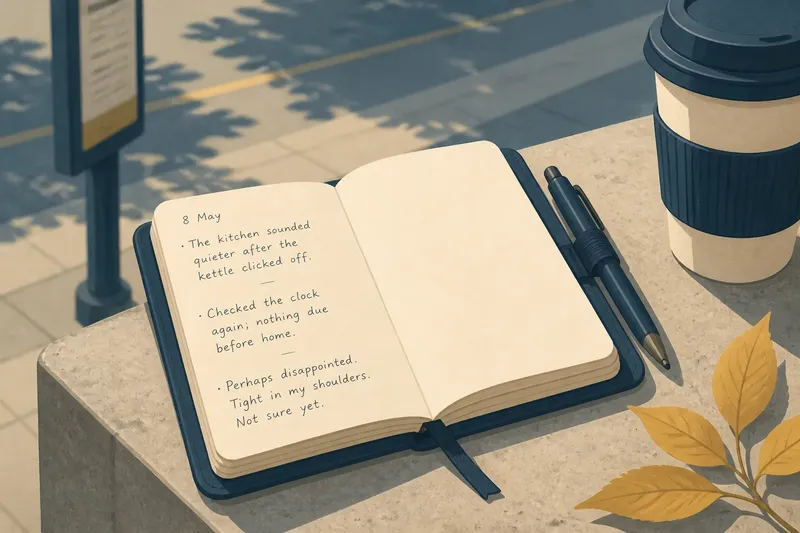
Reflection can preserve the shape of a moment: a phrase overheard, a bodily feeling, a change in the light or a thought that arrived during an ordinary task. “The kitchen sounded quieter after the kettle clicked off” can remain exactly that.
Keep an entry close to what you actually noticed. “I felt relieved when the meeting ended” describes an experience; “I always avoid difficult people” turns one moment into a sweeping claim. The first leaves room to revisit the feeling without treating it as a final account.
Say you are waiting for a bus and notice that you keep checking the time, though nothing urgent is due. You write, “Checked the clock again; nothing due before home.” The starting point is the repeated glance and the unhurried wait; the action is to record both in a line. The result is a note that preserves the behaviour and its setting without deciding whether it means impatience, habit or boredom.
A fragment, question mark or unfinished sentence can suit the moment better than a polished paragraph. Add only enough context for the detail to be recognisable later.
Match the note to the moment
When a detail may vanish quickly
Write one concrete thing: a colour, sound, phrase or gesture. Add a few words about where it happened if that will help you recognise it later. This keeps the note brief when a longer entry would pull your attention away.
When an emotion is unclear
Record it tentatively: “perhaps disappointed”, “tight in my shoulders” or “not sure yet”. You can add what happened immediately beforehand, but you do not need to explain the feeling or assign blame.
When a thought keeps returning
Write the thought once, then add a question such as “What else might be true?” You do not have to answer on the page. The question marks the thought without requiring you to rehearse it until it feels settled.
When you have little time
Use a short phrase or a symbol you understand. A date can help place the note, but headings and categories are optional. If writing would interrupt an important conversation or distract you in an unsafe place, wait.
Protect privacy with ordinary habits
Keep paper somewhere you can close and put away. On a phone, use its screen lock and check whether notes appear on shared devices. If other people handle your belongings, choose a storage place that makes sense for your circumstances.
When a note concerns someone else, record what you observed and how it affected you rather than adding personal details you do not need. The notebook is for attending to your experience, not building a record of another person.
It is not worth delaying your first entry to choose a special pen, decorate pages or devise a colour-coded system. If a method makes you hesitate, use a plain page and write the detail you want to keep.
What should you do with old notes?
There is no need to review every page or give old entries a job. Keep, revisit or discard a note according to whether it feels useful, welcome and private to you now.
Should you reread every entry?
No. Reread when you feel curious or when a note may be useful, not because a notebook needs regular review. If looking back makes you judge an earlier version of yourself harshly, close the book and return to the present.
Should an observation become an action?
Only if it points to something you actually want to address. A recurring practical concern may belong on a separate task list, while a passing image can stay on the page as an observation.
What if an entry brings up a painful memory?
You can skip the page, cover it, remove it or stop rereading it. If the writing brings up distress that feels difficult to manage, consider speaking with a qualified mental health professional; a notebook does not replace care.
When should you discard old pages?
Keep only what you want to keep. If a note no longer feels useful or private, dispose of it in a way that suits its contents and your circumstances. You do not have to preserve every page as evidence of having lived through it.
Return to the page without judging the past
A pocket notebook for private reflection can hold small traces without demanding a conclusion. Choose a format you will reach for and write close to what you noticed. When you revisit a page, treat it as a record of what was visible then, not a ruling on who you are now.
Before closing the notebook, you can leave the next page blank. If you do, it will be ready for a new observation without requiring you to finish an earlier thought first.